
Xiangqi Engine History Research Report | Chinese Chess
A structured history of Chinese chess engines from the 1980s to 2026, covering major engines, protocols, and community tooling. The 1985-1990 Period → The 2006…
The 1985-1990 Period
1985: The first Acer Cup Computer Xiangqi Tournament was held in Taiwan. The participating programs had limited strength, but it pioneered computer Xiangqi competitions.
1987: Acer Chinese Chess (Jiangzu) began development. Yu Xishun independently completed the engine’s core code during his university years.
1988: A test version of Jiangzu defeated amateur players in small-scale testing in Taiwan, attracting attention from Acer.
1989: The 1st ICGA Computer Olympiad was held in London. Jiangzu won the gold medal with a record of 4 wins and 0 losses, becoming the first world champion of computer Xiangqi.
1990: The 2nd ICGA Computer Olympiad, Elephant (Xu Shunqin) won the gold medal; Jiangzu did not participate.
The 1991-1995 Period
1991: The 3rd ICGA, Jiangzu participated under the name Abyss, tying with Surprise for the gold medal.
1992: The commercial version of Jiangzu, “Xiangqi Master 3” (Xiangqi Dashi 3), was officially released. This version ran on the DOS platform and had a strength approximately equivalent to amateur 2-dan level.
1993-1994: Xiangqi engine development entered a “quiet period.” Commercial engine sales were sluggish, and academic research attention was low.
1995: The internet began to spread in China, and online exchange about Xiangqi engines gradually increased. Chess1 (Qi Yin) began development.
The 1996-2000 Period
1996: Test versions of Qi Yin circulated on the internet.
1997: Qi Yin was officially released, becoming one of the most popular Xiangqi engines on the Windows platform.
1998: Qi Yin’s user base rapidly expanded, becoming the leader in the Xiangqi software market.
1999: The Xiangqi Association promulgated the “Chinese Xiangqi Competition Rules” (1999 edition), providing a formal standard for engine rule implementation.
2000: The Yitian Chess online gaming platform began operation, becoming an important platform for Xiangqi engine testing.
The 2001-2005 Period
2001: ELP won gold at the 6th ICGA. Xiangqi engine strength continued to improve.
2002: ELP defended its gold medal at the 7th ICGA.
2003: ZMBL (Zongma Benliu) won gold at the 8th ICGA.
2004: Contemplation (Qianlv) won gold at the 9th ICGA. Mengru Shenji (MRSJ) won bronze. Huang Chen began developing ElephantEye.
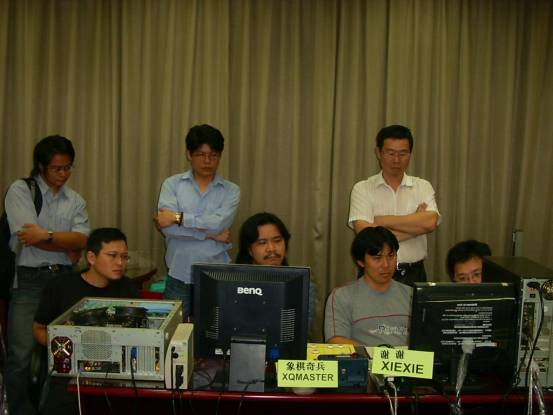
2005 10th ICGA Computer Olympiad — Match scene between Xiangqi Qibing (XQMASTER) and defending champion XieXie
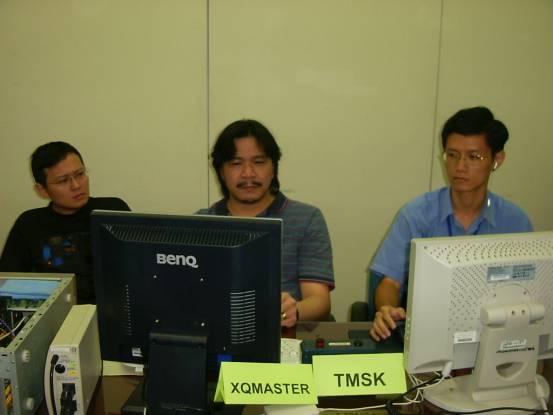
2005 10th ICGA — Match scene between Xiangqi Qibing (left) and Tianma Xingkong (TMSK, right)
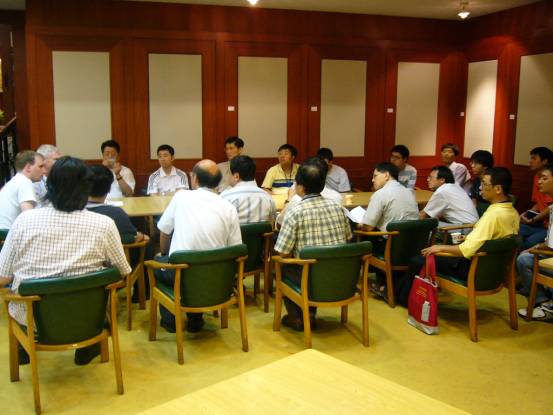
2005 ICGA Xiangqi event pre-competition technical meeting — Referees and participants discussing competition rules
2005: XQMASTER (Xiangqi Qibing) won gold at the 10th ICGA. Early versions of Xiangqi Xuanfeng began testing.
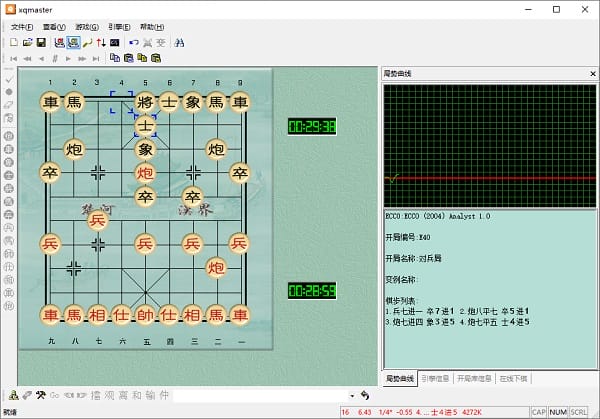
Xiangqi Qibing (XQMASTER) — The 2005 ICGA champion engine developed by Zhao Mingyang
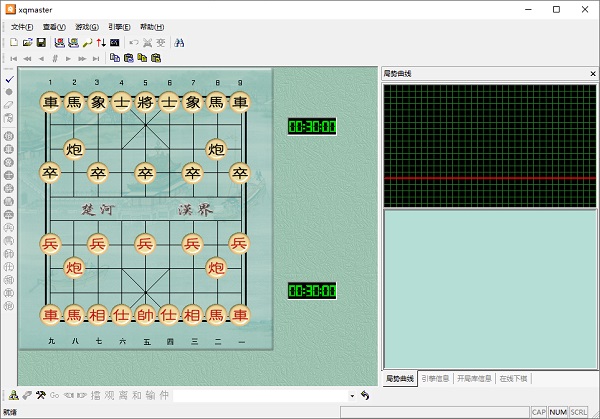
Xiangqi Qibing — Interface for playing against opponents
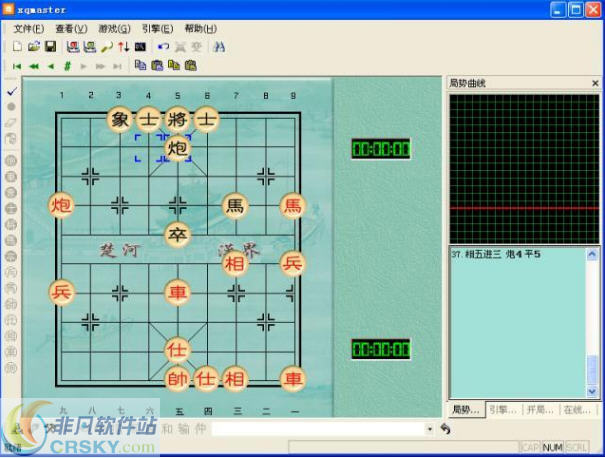
Xiangqi Qibing — Engine parameters and configuration interface
The 2006-2010 Period
2006: NEUChess (Qitian Dasheng) won gold at the 11th ICGA. The first CCMC was held in Beijing. The UCCI protocol was released by Huang Chen. Xiangqi engine strength reached the National Master level.
2007: Qitian Dasheng defended its title at the 12th ICGA and CCMC. Multi-threaded engines began to appear.
2008: Intella (Yitian Xiangqi) won gold at the 13th ICGA in Beijing. Xiangqi engine strength began to surpass some human Grandmasters.
2009: TMSK (Tianma Xingkong) won gold at the 14th ICGA. Xiangqi Mingshou won CCMC for the first time. Jiajia Xiangqi was first released.
2010: Shiga (Xiangqi Shijia) won gold at the 15th ICGA. Xiangqi Xuanfeng (Tornado) won CCMC.