
Xiangqi Engine History Research Report | Chinese Chess
A structured history of Chinese chess engines from the 1980s to 2026, covering major engines, protocols, and community tooling. Chapter 19 Xiangqi Game Notatio…
Chapter 19 Xiangqi Game Notation Editors and Translation Tools
19.1 Evolution of Game Notation Editor Functions
Xiangqi game notation editors evolved from the earliest plain text formats to support interactive notation editing and engine analysis.
Text Editor Stage (1990s):
- Moves recorded in text format (such as Chinese numerals: 炮二平五, 马8进7, etc.)
- Lacked graphical interface support
- Could not display board state in real time
Graphical Editing Stage (2000s):
- Graphical interface allowed users to move pieces by dragging with a mouse
- Supported real-time display and editing of game notation
- Supported annotations, variations, and branching records
- Supported import and export of game notation (XQF format, etc., XQF was created by XQStudio and became a de facto standard)
Engine Integration Stage (2010s–Present):
- Game notation editors deeply integrated with engines
- Can call engine analysis in real time
- Support best move display, variation analysis, deep search
- Online editors can run in web browsers
19.2 Translation Tools and Multilingual Support
With the internationalization of Xiangqi, multilingual translation tools for game notation have become important:
- Move Translation System: Translates Chinese notation (such as “马8进7”) into English format (such as “N2+3”) or descriptions in other languages.
- Position Description Translation: Translates position evaluation descriptions (such as “Red slightly better,” “Black winning,” etc.) into corresponding descriptions in other languages.
- Internationalization of FEI (Game Notation Format): Makes Xiangqi FEN and move formats understandable to the chess community.
19.3 Game Notation Transmission and Sharing Mechanisms
The transmission and sharing of Xiangqi game notation evolved from text copying to cloud synchronization:
FEN Protocol Sharing: An important application of FEN is sharing specific chess positions over the network. Through FEN parameters in web links, precise board states can be shared. For example, a shared game link might contain parameters in the following format:
https://example.com/analysis?fen=rnbakabnr/9/1c5c1/p1p1p1p1p/9/9/P1P1P1P1P/1C5C1/9/RNBAKABNR w
Cloud Synchronization Features: Modern game notation editors support cloud saving and synchronization, allowing users to access their game notation libraries from different devices.
19.4 XQStudio (Xiangqi Studio)
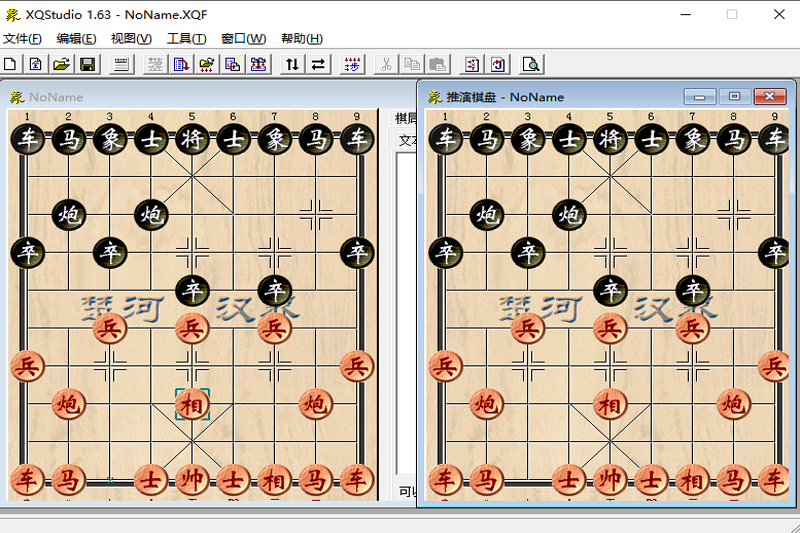
XQStudio main interface — the most influential free notation-editing software in the field of Xiangqi, created by developer Dong Shiwei (online alias "Guohe Xiang") in 1998
XQStudio (Xiangqi Studio) was created by developer Dong Shiwei (online alias “Guohe Xiang”) in 1998~1999, initially released on the Shuimu Tsinghua BBS. The first Beta version was released in December 1998, and version 1.0 was officially released in February 1999. The software was completely free, written in Delphi (Pascal), with the final version being 1.63 (circa 2008), later open-sourced by the author on NewSMTH in 2008 with full source code.
As the most influential notation-editing software in the Xiangqi field, XQStudio supports game notation recording, multi-branch variations (tree-shaped variation tree), step-by-step move annotation, position search, auto-play, and simultaneous management of multiple game records. It uses a binary tree left-child right-sibling method to store the move tree, supporting the entry of variations starting from the very first move, so a single XQF file can store an entire opening textbook, rather than just a single game.
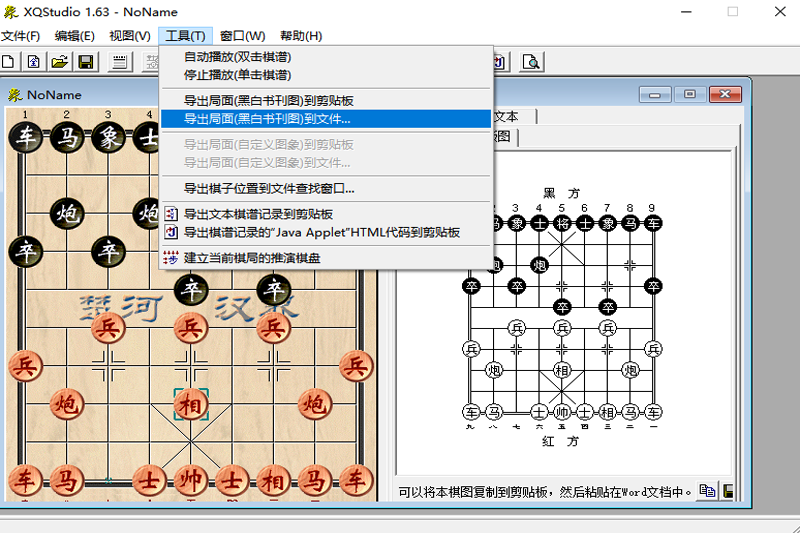
XQStudio game notation editing interface — supporting multi-branch variations, annotations, and position search
The XQF file format is XQStudio’s native format, containing a 10-byte file header identifier, 32-byte position encoding, 64-byte file comments, and move data recorded in alternating red/black turns. In April 2001, the author officially published the XQF 1.0 format specification under the alias “Guohe Xiang.” The XQF format was later supported by numerous software and websites such as Xiangqi Bridge, Xiangqi Wizard, Dongping Xiangqi Network (dpxq.com), and Game Notation Collection Station, becoming the de facto standard for electronic Xiangqi game notation. It remains a commonly used tool for Xiangqi referees, notation editors, and opening researchers.
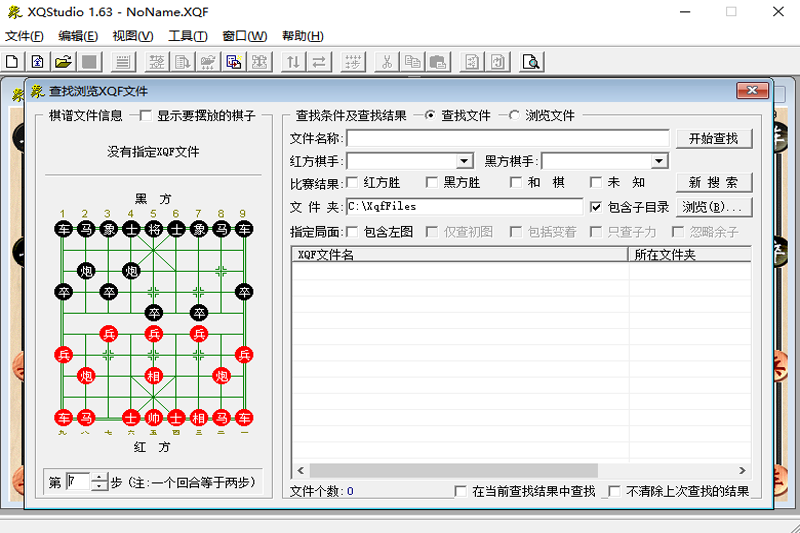
XQStudio game notation management and analysis functions — the software is only 476 KB, green portable, compatible with all Windows systems
19.5 CCBridge (Xiangqi Bridge / xqbridge)
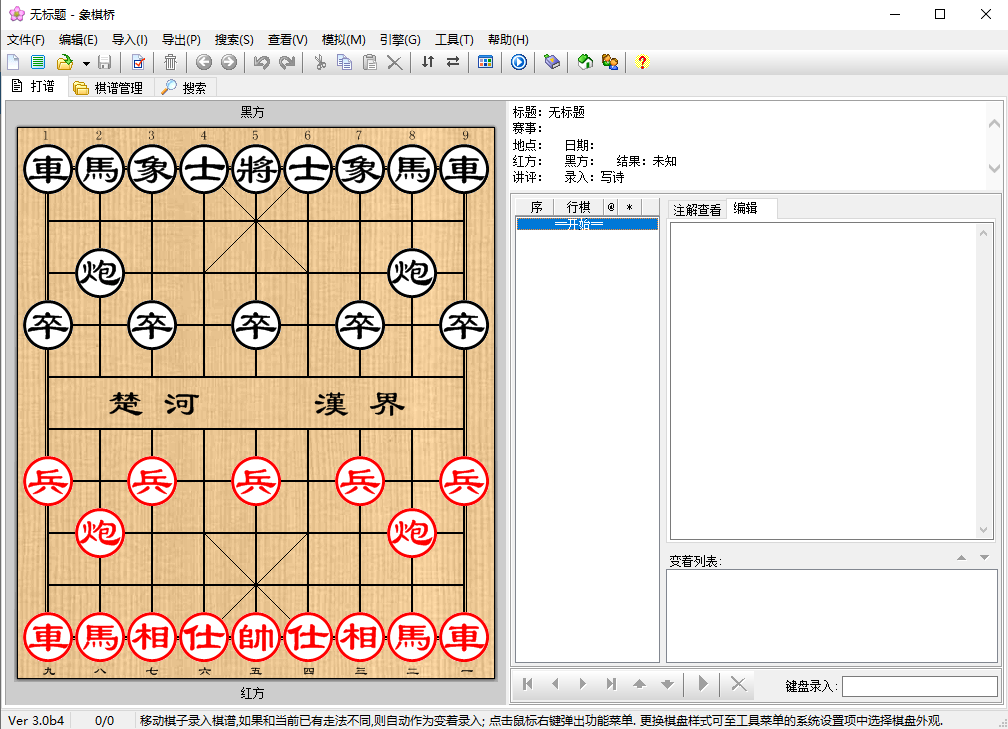
CCBridge main interface — a Xiangqi game notation management system, hailed as "the most comprehensive Xiangqi game notation library in the world"
CCBridge (Chinese Chess Bridge) is a free Xiangqi game notation management system created by an individual developer. Its early versions date back to the mid-2000s, making it one of the most important notation-editing software programs in the Xiangqi software ecosystem after XQStudio. The software is developed in C++, supports Lua script extensions, with native formats being CBR/CBF (single-game notation) and CBL (game library), while also being compatible with the XQF format.
CCBridge’s core advantage lies in its powerful game notation management capabilities: it comes pre-loaded with over 300,000 game records across eight major categories (Cup Tournaments, Opening Library, Master Games, Classical Manuals, Huashan Game Library, Endgame Studies, Chess Research Exploration, Xiangqi Series), and supports conversion between virtually all mainstream game notation formats including XQF, PGN, MXQ, CHE, CCM, CBR, CBF, and CBL. It features a unique pinyin/numeric keyboard input method (e.g., p2p5 or 6225 corresponding to 炮二平五), supports UCCI engine human-machine play and position analysis, and allows high-speed multi-dimensional search by position, material, opening, or player — searching 1 million games for a board position takes only 0.3 seconds. Its version history progressed from 1.x to 2.x, ultimately settling at the final 3.0.4 release.
Compared to XQStudio, CCBridge leans more toward game notation database management and comprehensive training platforms, while XQStudio focuses on pure notation recording and light analysis. CCBridge significantly outperforms XQStudio in variation viewing, multi-format conversion, and engine integration, but XQStudio, due to its publicly available source code, has had a deeper impact in the realm of secondary development. CCBridge remains a commonly used tool for many veteran chess enthusiasts to organize and study game records.
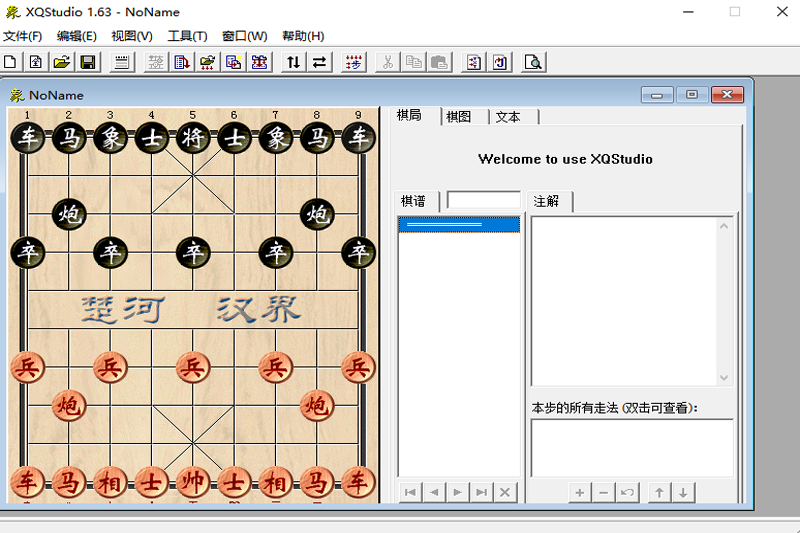
XQStudio variation tree management function — stores the move tree using a binary tree method, supporting multi-route variations entered from the very first move
Chapter 20 Summary: Deep Patterns in Xiangqi Engine Development
20.1 Redefining from “Strength” to “Intelligence”
The development history of Xiangqi engines is essentially a transformation from “how to make the computer move faster and more accurately” to “how to make the computer understand better and deeper.”
Phase 1 (1980s-1990s): Strength = Calculation Speed
In this phase, engine strength was almost entirely determined by calculation speed. Under the condition of relatively simple evaluation functions and search algorithms, the number of nodes that could be searched per second directly determined the engine’s level.
Phase 2 (2000s-2010s): Strength = Search Efficiency + Evaluation Quality
Optimization of search algorithms (PVS, various pruning techniques, transposition tables, parallel search) and evaluation functions meant that strength was no longer determined solely by calculation speed. An engine with high search efficiency and accurate position evaluation could achieve greater strength at lower speeds.
Phase 3 (2020s–Present): Strength = Data + Network + Search
In the NNUE era, “strength” is comprehensively determined by training data quality, network structure design, and search algorithms.
20.2 Future Development Trends
Competition Between Open Source Engines and Commercial Engines
The success of Pikafish has proven that open source engines can surpass commercial closed source engines in strength. In the future, open source engines may further expand their advantage, especially in the field of NNUE training (which requires substantial GPU computing power), where the open source community can obtain computing resources far exceeding those of any single company through crowdsourcing.
Globalization of Collaboration
The Xiangqi engine community is transitioning from a “Chinese community” to a “global community.” Interest from non-Chinese speakers (especially developers from the chess community) in projects like Pikafish is increasing, which may bring new technical perspectives and contributions.
Educational Value
The value of Xiangqi engines as teaching cases for computer game-playing will become more prominent. Pikafish’s open source codebase is an excellent learning resource — it demonstrates the comprehensive application of modern search algorithms, neural network evaluation, distributed testing, and other technologies.
20.3 Why There Was No “Deep Blue Moment” for Xiangqi Engines
A question worth pondering is: why have Xiangqi engines never had a “milestone event” with global impact like Deep Blue in chess?
Reason Analysis:
- Lack of large enterprise investment: IBM invested tens of millions of dollars in Deep Blue; Xiangqi has never received comparable commercial or government investment.
- Lower academic attention: Chess has deep academic traditions in AI research, while the number of academic papers on Xiangqi in computer science is far lower than for chess.
- Unclear market value: In China, the direct commercial value of Xiangqi software is relatively limited, making it difficult to attract large-scale capital investment.
- Differences in popularity: The global popularity of chess far exceeds that of Xiangqi. Deep Blue’s victory was hailed as “a milestone of human intelligence facing machines,” attracting worldwide attention.
- Timing differences: By the time Xiangqi engines surpassed human grandmasters in the 2010s, AI technology had already entered the “deep learning era,” and public attention toward machines surpassing humans in board games had already declined.
- Identity factors: Xiangqi has rich traditional cultural connotations, and the process of accepting “computer chess playing” was slower than in the chess community.
However, this situation of “no Deep Blue” also yielded a unique result: the development of Xiangqi engines has been more “grassroots” and more distinctly community-driven. It proves that a community, without large capital support, can also create world-class software products through open collaboration and continuous optimization.
20.4 Deep Patterns in Xiangqi Engine Development
Reviewing more than thirty years of development history, we can summarize several deep patterns in Xiangqi engine development:
Pattern 1: Algorithm Progress > Hardware Progress. Under the same hardware conditions, improvements in search algorithms (from Minimax to Alpha-Beta to PVS with various pruning techniques, from hand-crafted evaluation to NNUE) have brought far greater strength improvements than hardware generational changes.
Pattern 2: Open Source Collaboration > Individual Closed Source. Pikafish achieved in just over two years a level of strength surpassing the closed source development achievements of many teams over many years, proving the efficiency advantage of open source collaboration.
Pattern 3: Data > Code. In the modern NNUE era, the importance of training data and cloud book data has surpassed the engine code itself. Those who can obtain more and higher quality position evaluation data can train more powerful neural networks.
Pattern 4: Community > Algorithm. From a broader perspective, the organizational efficiency of the community determines the speed of engine progress. An active, open technical community can drive long-term technological development far more effectively than a single genius developer.
Pattern 5: Chess Route > Independent Development Route. Compared to independent development from scratch, “standing on the shoulders of Stockfish” for Xiangqi adaptation can greatly reduce development costs and shorten development cycles. The success of Pikafish proves the effectiveness of this technical route.
Pattern 6: Standardization > Fragmentation. The standardization of UCCI and UCI protocols, the popularization of the FEN format, and the introduction of the Fishtest framework — each standardization has significantly promoted the development of the engine ecosystem.
Volume IV Special Topics
Chapter 21 Evolution of Computer Game Rules: A Technical History of Long Check/Long Chase Detection
21.1 The Technical Impact of Rule Complexity
The cyclic move rules of Xiangqi (long check, long chase, one check one chase, one check one idle, two attacks one counter-attack, etc.) are among the most difficult technical challenges in engine development. Unlike the threefold repetition rule in international chess, Xiangqi rules require distinguishing between different types of cyclic moves and determining which are “permitted moves” and which are “prohibited moves.”
Version Evolution of the Rule System:
The competition rules of Xiangqi have undergone multiple revisions over the past decades:
- Chinese Xiangqi Competition Rules (1999 Edition): Promulgated by the Chinese Xiangqi Association, this was the first systematized modern competition rule set.
- Asian Xiangqi Competition Rules: Promulgated by the Asian Xiangqi Federation, these differ from the domestic rules and are primarily used for Asian international events.
- Chinese Xiangqi Competition Rules (2011 Edition): Revised the definition of cyclic moves, further clarifying the judgment standards for concepts such as “long check” and “long chase.”
Key differences between the various rule systems include:
- The definition and penalty for “long check”
- The distinction between “long chase” and “long block”
- The judgment standard for “one check one chase”
- The handling of “two attacks one counter-attack” cycles
Challenges for Engine Implementation:
For Xiangqi engines, perfectly implementing the cyclic rules presents the following difficulties:
-
Position History Recording: The engine needs to record the move history to detect cycles. This requires storing detailed information about each move (including captures), not just relying on position hashing. This is because even if a position after a capture has the same hash as a previous position, the ruling may differ due to rule restrictions (a piece that has just captured cannot be immediately recaptured, etc.).
-
Move Classification: The engine needs to determine whether each move belongs to categories such as “check,” “chase,” “block,” “check (将),” “sacrifice (献),” etc. Among these, “chase” judgment is the most complex — it requires assessing whether the move threatens to capture an opponent’s piece on the next turn. This is essentially a “mini-search” problem: it requires simulating the protection status of each opponent’s piece to determine whether it can be captured.
-
Recursive Cycle Detection: In long-check/long-chase positions, complex recursive cycles may form, requiring a precise state machine for judgment. For example, a complex cycle of “Red perpetually checks → Black evades → Red continues perpetually checking → Black continues evading” may occur.
-
Rule Conflicts: When the rules used by the engine (e.g., Asian rules) are inconsistent with the rules used by the online platform (e.g., Chinese rules), situations may arise where “the engine’s move is correct but the platform rules it as a violation.” This is especially common in high-level automated play.
Evolution of Implementation Approaches:
Early Xiangqi engines (such as Jiangzu/Elite and Qiyin) used simple repeated-position detection — if a position appeared three times, it was declared a draw. While simple, this approach deviated from official competition rules. From a technical standpoint, this was a “lazy” implementation, but for early engines with limited playing strength, the impact of rule accuracy on actual play was minimal.
Mid-period engines (such as Cyclone and Mingshou) began to introduce move classification systems. The engine would analyze the type of each move, assigning different handling strategies for “long check” and “long chase” moves. The rule-processing modules of these engines typically included:
- A state machine for cyclic moves
- A move classifier capable of identifying “check” and “chase”
- Rule-based penalty logic
Modern engines (such as Pikafish) have achieved more complete rule coverage. Pikafish’s cyclic rule handling has undergone several major updates:
- Initial version: Basic threefold repetition detection
- 2022-12-26 version: Introduced the 60-move rule, improved threefold repetition detection
- 2024-08-31 version: Updated rule logic — “if a checking move appears in the repeating move sequence, the sequence is no longer considered a chase sequence”
Pikafish also allows users to select different rule systems (Asian rules / Chinese rules) through UCI options, adapting to the requirements of different platforms.
21.2 Differences Between Asian and Chinese Rules and Engine Adaptation
The Asian rules and Chinese rules differ in the following major ways regarding the judgment of cyclic moves in Xiangqi:
Difference 1: Long Check Judgment
Both rule systems prohibit long checks, but there are subtle differences in the specific method of judgment. The scope of long check definition in Asian rules is broader than Chinese rules in certain situations.
Difference 2: Long Chase Judgment
Asian rules and Chinese rules diverge in the definition of “long chase.” For example, when one side uses the same piece to continuously threaten multiple different opponent pieces, the two rules may have different rulings.
Difference 3: One Check One Chase Judgment
For “one check one chase” (alternating between one checking move and one chasing move), the rulings of the two rules may differ.
Engine Adaptation Strategies:
To adapt to the rule requirements of different platforms, modern engines typically provide a rule-switching feature. Pikafish allows users to select “Asian Rules” or “Chinese Rules” via UCI options. This flexibility enables the same engine to run correctly on different platforms.
Chapter 22 Zobrist Hashing and Transposition Tables Adapted for Xiangqi
22.1 Implementation of Zobrist Hashing in Xiangqi
Zobrist hashing is the most commonly used position hashing technique in chess engines. Its principle is: assign a random number to each possible state of each piece at each position, then XOR all the random numbers of the pieces on the board to obtain a fixed-length hash value.
In Xiangqi, Zobrist hashing needs to adapt to the following special requirements:
- Piece Types: 7 types of red pieces + 7 types of black pieces = 14 piece types
- Board Positions: 9×10 = 90 intersection points
- Kings Facing Each Other: The facing state requires additional encoding, usually represented by specific bits of the hash value
- Side to Move: Whose turn it is needs to be encoded
- Cycle Information: Some engines encode partial cycle information into the hash value
The advantage of Zobrist hashing lies in its incremental update property: when moving a piece, you only need to XOR out the random numbers of the old and new positions from the hash, then XOR in the new random numbers. This property makes the computation complexity of updating the hash after each move O(1), independent of board size.
22.2 Special Xiangqi Considerations in Transposition Tables
Transposition Tables avoid redundant computation by caching search results for positions that have already been evaluated. In Xiangqi, the use of transposition tables faces challenges not present in international chess:
-
Cyclic Move Rules: In international chess transposition tables, encountering a position with the same hash can directly return the result (because threefold repetition means a draw). But in Xiangqi, three occurrences of the same position do not necessarily mean a draw — it could be a complex situation like “two attacks one counter-attack” or “one check one chase.”
-
King-Facing Symmetry: In Xiangqi, the same position viewed from Red’s perspective and Black’s perspective may have different symmetry properties (because the movement restrictions of the King and General differ), which affects the transposition table hit rate.
-
River Asymmetry: The same piece configuration on either side of the river may have completely different tactical implications, so evaluation values for “mirror positions” cannot be directly interchanged. For example, a Rook on Red’s side controlling the river has a different tactical value compared to a Rook on Black’s side controlling the river.
Transposition Table Size and Performance:
The size of the transposition table has a direct impact on engine performance. An overly small transposition table leads to frequent hash collisions and entry replacements, reducing cache efficiency; an overly large table wastes memory and may reduce cache access speed. Typical Xiangqi engine transposition tables range from 64 MB to 256 MB, with large engines possibly using 512 MB or 1 GB.
Chapter 23 Yitian Qiyuan and the Culture of Online Human-Computer Battles
23.1 History of the Yitian Qiyuan Platform
Yitian Qiyuan (Yitian Chess Garden,简称"弈天") was one of China’s earliest online Xiangqi playing platforms. Founded in the late 1990s and reaching its peak in the early 2000s, it is an important platform in the history of Xiangqi engine development that cannot be overlooked.
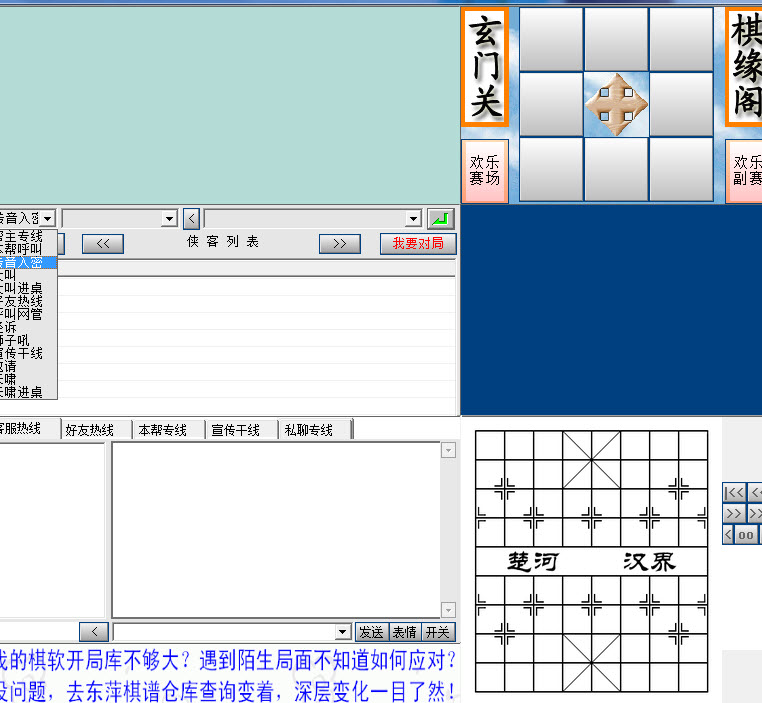
Yitian Qiyuan client main interface — one of China's earliest online Xiangqi battle platforms
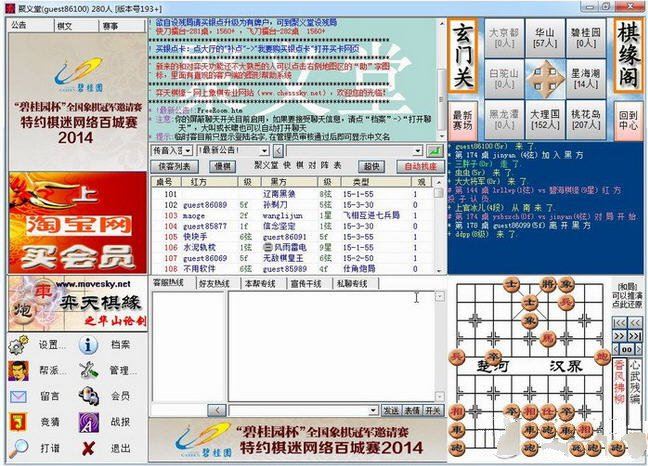
Yitian Qiyuan — high-level play on the Huashan-Lunjian server

Yitian Qiyuan user login screen

Yitian Qiyuan desktop icon
Creation and Development of Yitian:
Yitian Qiyuan was originally created by individuals or a small team. With its stable service and active community, it quickly attracted a large number of Xiangqi enthusiasts. At its peak, Yitian had several thousand concurrent online users, with tens of thousands of games occurring daily.
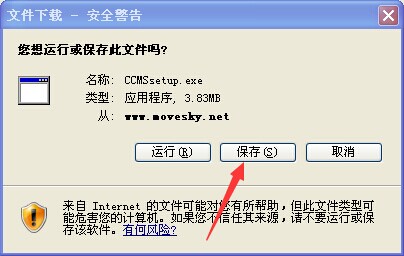
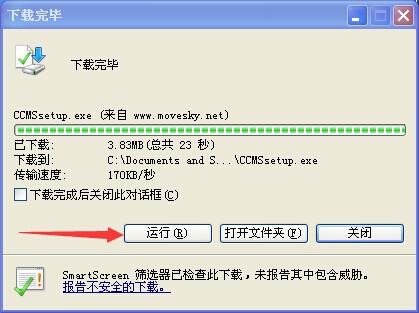
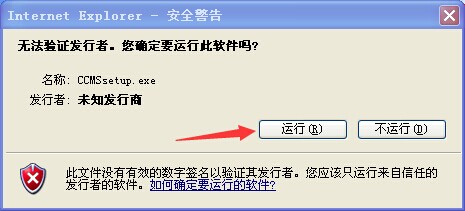
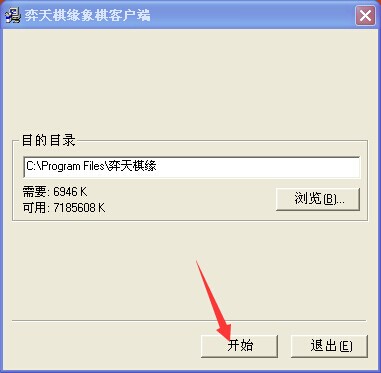

Yitian Qiyuan client registration and installation process screenshots
Yitian’s main features included:
- Real-time online play (supporting blitz, slow chess, and other time controls)
- Game notation recording, playback, and review
- ELO rating system
- Human vs computer play
- Tournaments and challenge matches
Yitian’s Impact on Xiangqi Engine Development:
-
Engine Testing Ground: Yitian was the preferred testing platform for engine developers and enthusiasts. Engine authors would run their engines on Yitian, battle against other engines or human players, and collect test data and feedback.
-
Human-Computer Battle Culture: Yitian was the first platform to popularize the “human-machine collaboration” model on a large scale. Users could leverage engine analysis to assist decision-making while playing on Yitian, creating a unique human-machine collaborative battle culture.
-
Huashan Lunjian: Yitian’s “Huashan” (华山) server was synonymous with high-level play. Players who could compete on Huashan typically represented the highest level of human-machine collaboration at the time.
-
ELO Rating: Yitian’s rating system provided a public reference standard for the quantitative evaluation of engine playing strength. Although Yitian’s rating system was not rigorous, it was a long-term available metric within the community.
23.2 The Cultural Significance of Human-Computer Battles

JJ Chess — an online Xiangqi battle platform under Jingji World (JJ), known for integrating prize-pool tournaments with casual play
JJ Chess (JJ象棋) is an online Xiangqi battle platform launched by Jingji World (Beijing) Network Technology Co., Ltd. Unlike traditional playing platforms, JJ Chess combines chess competition with tournament prize mechanisms, creating a unique competitive + entertainment model. JJ Chess features beautiful game interfaces and a comprehensive tournament system, attracting a large number of Xiangqi enthusiasts.

JJ Chess game main interface — polished UI design and rich tournament entry points

JJ Chess online game interface — supports multiple time controls and room settings

JJ Chess tournament system — prize-based competitive tournaments attract high-level players

JJ Chess game notation review and sharing function

JJ Chess rating and ranking system — incentivizes continuous play to improve rank
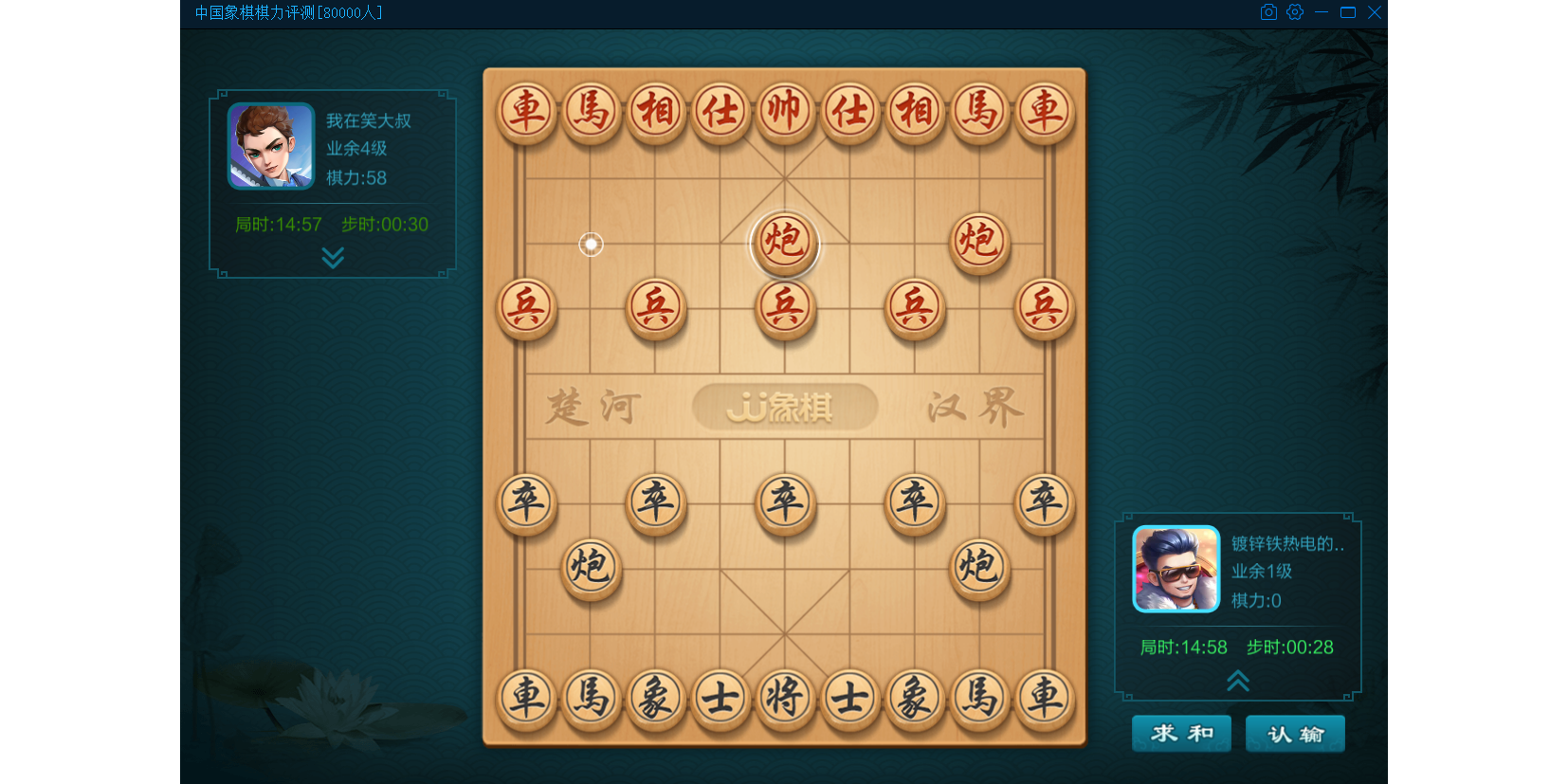
JJ Chess mobile client — Xiangqi battle experience on mobile

JJ Chess endgame challenge — interesting endgame level design
The culture of human-computer Xiangqi battles differs significantly from international chess. In international chess, top-level human-computer matches (such as Deep Blue vs. Kasparov) were typically spectacular “human society vs. machine” performances. In Xiangqi, however, human-computer battles more often manifested as “human + machine collaboration” — players used engine analysis as an auxiliary tool but retained autonomous judgment in decision-making.
This “human-machine collaboration” culture formed for several reasons:
- Xiangqi engines had already surpassed the level of human grandmasters by the late 2000s
- The outcome of pure “human vs. machine” matches was already without suspense by that time
- The “human + machine” model offered a new competitive form — testing one’s ability to select and use engines
- Online platforms (such as Yitian) naturally supported the “human + machine” operating mode
- The Xiangqi community had a high acceptance of “human-machine collaboration,” without the “cheating controversy” seen in the international chess world
Chapter 24 OurGame (Lianzhong): The Pioneer and Rise-Fall of China’s Online Xiangqi Platform

OurGame (Lianzhong) Logo — one of the earliest large-scale online casual game platforms on the Chinese internet, founded by Bao Yueqiao, Jian Jing, and Wang Jianhua in 1998
24.1 The Founding and Historical Status of OurGame (Lianzhong)
OurGame (Lianzhong, 联众) was one of the earliest large-scale online casual game platforms on the Chinese internet and the true pioneer of China’s online Xiangqi platforms. Its founding and development witnessed the complete journey of the Chinese internet from dial-up to broadband adoption.
Founding Background (1998):
On March 23, 1998, three first-generation Chinese programmers — Bao Yueqiao (鲍岳桥), Jian Jing (简晶), and Wang Jianhua (王建华) — founded OurGame in Beijing with a loan of 500,000 RMB. The backgrounds of these three founders were remarkable:
- Bao Yueqiao: Developer of UCDOS. UCDOS was the most popular Chinese operating system in the DOS era, installed on nearly every Chinese computer. Bao Yueqiao himself was a Go enthusiast who often played on IGS (a Korean Go server), which inspired him to create China’s own online casual game platform.
- Jian Jing: Developer of the “Chinese Dragon” (中国龙) Chinese system.
- Wang Jianhua: Also had a strong software development background.
On June 3, 1998, the OurGame server went live on Oriental Network (东方网景), initially with only 5 games: Go, Chinese Chess, Jungle (军棋), Upgrade (升级), and Gong Zhu (拱猪). At launch, there were only a few dozen concurrent online users. To retain users, Bao Yueqiao often registered 3 fake accounts to play against real users — a tactic similar to Ma Huateng’s early strategy at QQ of “pretending to be a girl to chat with users.”
OurGame’s Rapid Rise (1998-2003):
OurGame’s growth rate was astonishing. By the end of 1998, concurrent online users exceeded 1,000. In 2000, OurGame hosted the “Haihong Cup Chinese Chess Tournament” with over 12,000 participants, setting a world record for online tournament scale at the time.
2003 was OurGame’s peak year:
| Metric | Data | Description |
|---|---|---|
| Registered Users | 200 million | Total Chinese internet users at the time were only about 80 million |
| Monthly Active Users | 15 million | Far exceeding any Chinese internet platform at the time |
| Peak Concurrent Online | 720,000 | Across all games (Xiangqi, Go, card games, etc.) |
| Market Share | ~85% | China’s online casual game market |
| Xiangqi Concurrent Users | 80,000-100,000 | Xiangqi was one of OurGame’s most popular games |
In 2003, OurGame simultaneously held the records of “first in registered users in China” and “first in global concurrent online users,” known as “North OurGame, South Zhongyou” (北联众、南中游). It was China’s first true internet game giant — predating Tencent, NetEase, and Shanda.
Innovative Features of OurGame’s Xiangqi Platform:
OurGame’s Xiangqi platform had the following pioneering features at the time:
-
ELO Rating System: OurGame pioneered China’s first ELO-based rating system, with ranks from Level 9 Player (<1100 points) to Grandmaster (>=2600 points). Using the formula Rn=Ro+K*(W-We), the K value was dynamically adjusted based on rating range (32/24/16/8).
-
Verified Title Authentication: Provided special star identifiers for real-life Xiangqi masters and grandmasters (International Grandmaster, National Grandmaster, International Master, National Master), linking online identities with offline titles.
-
Clan System: The “OurGame Jianghu” (联众江湖) system launched in 1999, allowing players to create “clans” (similar to guilds), organize clan wars, and build deep social communities. This was the first truly user-driven social community system in Chinese internet history.
-
Large-Scale Tournament Engine: Supported tournament systems with thousands of concurrent players, managing real-time elimination brackets.
-
Spectating and Betting: Real-time spectating of expert games with virtual currency betting.
-
Game Notation and Analysis: Built-in endgame database, notation review, and position trend curve analysis.
-
Multiple Game Modes: Standard play, handicap play, setup mode, flip chess, etc.
-
Professional Edition: Chinese Chess Professional Edition, adding professional rules, handicap, and setup functions.
24.2 The Decline of OurGame: A Multi-Dimensional Systemic Collapse
The decline of OurGame is one of the most classic cases in Chinese internet business history. It was not caused by a single factor but was a systemic superposition of strategic miscalculation, competitive pressure, capital traps, and management chaos.
I. The Fatal Blow from Tencent QQ Games (External Competition Factor)
In August 2003, Tencent launched the QQ Game platform, initially with only 5 games (Upgrade, Four-Player Military Chess, Xiangqi, Fight the Landlord, Stud Poker) — these games were almost identical to OurGame’s game lineup. Tencent’s entry dealt a devastating blow to OurGame.
Bao Yueqiao later recalled that he personally tested QQ Games and thought “it was too poorly made, completely nothing to worry about.” His judgment at the time was that QQ Games was pure imitation and that OurGame’s product quality far surpassed it. Based on this judgment, Bao Yueqiao made one of the most fatal decisions in OurGame’s history: diverting major development resources to the “OurGame New World” project, stopping updates and maintenance of the original OurGame lobby.
Bao Yueqiao’s key mistake was not recognizing that Tencent’s weapon was not product quality but social network effects. QQ already had over 200 million users. Tencent added a “what games your friends are playing” feature in the QQ client — users could click to jump directly to QQ Games. The effect of this social fission was devastating. OurGame employees later recalled watching users churn away, powerless to stop it.
In April 2004, Bao Yueqiao went alone to Tencent’s headquarters in Shenzhen, hoping to meet Ma Huateng face to face. Ma Huateng refused to see him. Bao Yueqiao reflected years later: “Thinking back now, I was too naive. The rules of casual games are fixed — there’s no technical barrier. And our users completely overlapped with QQ’s users. Tencent could replicate us effortlessly.”
The consequences were brutal:
- September 2004 (just one year later): QQ Games’ concurrent online users surpassed OurGame, becoming China’s largest casual game platform
- Q3 2006: QQ Games had 2.56 million concurrent online; OurGame had only 500,000 (one-fifth of QQ Games)
Bao Yueqiao distilled a principle from this defeat that he follows to this day: “I only invest in things Tencent won’t do or can’t do. I will absolutely not touch games anymore.”
II. The Capital Trap of NHN’s Stake (Corporate Governance Factor)
In April 2004, OurGame sold over 50% of its equity to Korea’s NHN Group for $100 million. This decision is considered the second most fatal factor in OurGame’s decline.
Problems brought by NHN’s investment:
- Cultural Conflict: Korean management did not understand Chinese user needs; decision-making power shifted from Beijing to Seoul.
- R&D Team Dismantled: NHN did not support OurGame’s domestic R&D; Chinese developers were laid off or reassigned.
- Loss of Independent R&D Capability: OurGame lost its core technical team, instead relying on Korean technical resources.
- Missed DNF: An NHN subsidiary developed DNF (Dungeon & Fighter), but NHN failed to capitalize on this IP. DNF was later handed to Tencent for operation, becoming one of the most profitable online games in China.
The most catastrophic decision occurred in 2009: Korean engineers decided to completely abandon the OurGame lobby and rebuild the entire platform from scratch. This project took 3 years, cost over 100 million RMB, and consumed all of OurGame’s resources. During the rebuild, existing business was completely neglected; known bugs went unfixed for years, and user experience continuously deteriorated. OurGame began incurring losses in 2009.
Jian Jing and Wang Jianhua left OurGame in 2003; Bao Yueqiao was forced out in 2006. The departure of all three founders marked OurGame’s loss of soul.
III. Failed Mobile Internet Transition (Technology Factor)
When the smartphone wave swept through China around 2010, OurGame made almost no effective response:
- QQ Games launched a mobile version in 2010, supporting one-click QQ login
- OurGame did not launch a mobile app until after 2013, requiring separate account registration — an unacceptable barrier in an era when WeChat login had become standard
- OurGame’s mobile app quality was poor, with users reporting login failures, disconnections, and crashes
- OurGame’s original core user base (40+) was completely abandoned on mobile
By 2016, the market had fully shifted to mobile, yet OurGame’s mobile game revenue still lagged behind PC, while competitors had already become mobile-native.
IV. Business Model Alienation: From Membership to Gambling (Compliance Factor)
After 2009, to reverse losses, OurGame began heavily promoting Texas Hold’em business. By 2017, Texas Hold’em accounted for over 20% of OurGame’s total revenue.
Texas Hold’em on OurGame was actually an elaborately designed disguised gambling system:
- Players could exchange virtual chips for cash through “silver merchants” (银商, gray market intermediaries)
- OurGame tacitly allowed and even fostered this ecosystem
- Platform revenue heavily depended on high-stakes players’ spending
This model ultimately led to OurGame’s destruction.
May 2018: The Chinese Ministry of Public Security launched a surprise investigation into OurGame, arresting 36 people including OurGame’s Vice President Qin and VIP customer managers. Investigations showed that since 2010, the cumulative gambling funds involved in OurGame’s Texas Hold’em exceeded 335 million RMB.
OurGame International (HK.06899) stock was suspended, with the share price falling from a peak of 1.45 HKD to nearly zero. CEO Wu Guoliang remained overseas. OurGame’s market capitalization fell from a peak of about 7 billion RMB to about 700 million RMB — an evaporation of over 90%.
V. Systematic Timeline of OurGame’s Decline:
| Year | Event |
|---|---|
| 2003.08 | Tencent QQ Games launched, directly copying OurGame |
| 2003 | OurGame stopped updating the original lobby, shifted to “OurGame New World” |
| 2004.04 | NHN acquired over 50% of OurGame’s equity for $100 million |
| 2004.09 | QQ Games surpassed OurGame to become China’s largest casual game platform |
| 2006 Q3 | QQ Games 2.56 million concurrent; OurGame only 500,000 |
| 2006 | Bao Yueqiao forced to leave OurGame |
| 2009 | Korean team decided to rebuild the OurGame lobby from scratch, costing over 100 million RMB, taking 3 years |
| 2009 | OurGame began annual losses |
| 2010 | NHN fully withdrew from China; OurGame bought back shares via MBO for ~$50 million |
| 2010 | OurGame began operating Texas Hold’em (gambling time bomb) |
| 2012 | Brief recovery: held 57.7% of web-based casual game market, 37 million MAU |
| 2014.06 | OurGame International listed in Hong Kong (HK.06899) |
| 2017 | First annual loss, all game categories declined |
| 2018.05 | Ministry of Public Security raid, 36 arrested, stock suspended |
| 2018 | Full-year net loss of 668 million RMB; Texas Hold’em banned nationwide |
| 2019 | Sold WPT (World Poker Tour), pivoted to overseas esports |
| 2024 | Revenue 92.19 million RMB, net loss 89.19 million RMB, auditor issued going-concern doubt opinion |
| 2026 | Still existing but merely a shadow of its peak, market cap ~$100 million |
24.3 OurGame’s Historical Legacy
Although OurGame has declined, its position in the history of Xiangqi’s online development is irreplaceable:
-
Pioneer: OurGame was China’s first online Xiangqi platform. When it launched on June 3, 1998, the total number of Chinese internet users was less than 1 million.
-
Model Definer: ELO ratings, room systems, chat, spectating, tournaments, guilds — all the basic features of today’s Xiangqi platforms were pioneered by OurGame.
-
First Social Gaming Community: The “OurGame Jianghu” clan system was the first truly user-driven social community in Chinese internet history. For a generation of Chinese netizens, OurGame represented their first memory of the internet.
-
Professionalization Promoter: Through verified title authentication, large-scale tournaments, and online-offline integration, OurGame advanced the legitimization of online Xiangqi as a serious competitive activity.
-
Industry Talent Cradle: Countless later Xiangqi platform product managers, developers, and community operators had worked at OurGame. OurGame’s talent spillover indirectly influenced every subsequent Xiangqi platform.
-
Classic Business Case: OurGame’s rise and fall is one of the most studied cases in Chinese internet business history — it demonstrates the consequences of underestimating platform competitors, the danger of losing company control, the trap of abandoning core capabilities to chase trends, and how short-sighted gambling revenue can destroy a twenty-year-old enterprise.